
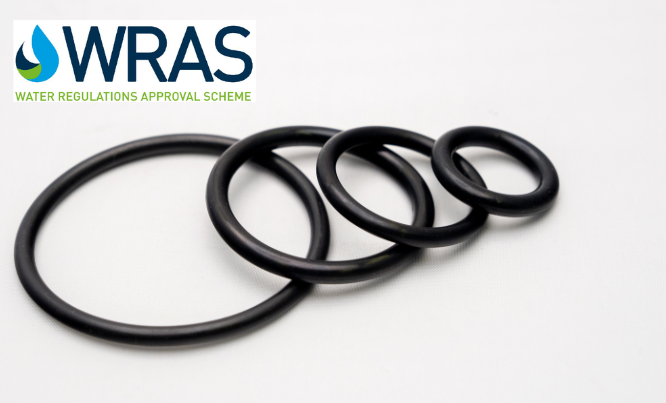
Ensuring the Safety and Compliance of Materials for Potable Water
Ensuring the safety and compliance of materials in contact with drinking (potable) water is a critical responsibility for engineers, manufacturers, and contractors in the UK. The Water Regulations Advisory Scheme (WRAS) provides a robust framework to certify materials for potable water use, verifying that products will not compromise water quality, public health, or system performance.
Is WRAS Approval a Legal Requirement?
While WRAS approval itself is a voluntary certification and not a legal requirement, compliance with the Water Supply (Water Fittings) Regulations (or Scottish Byelaws) is mandatory by law.
In the context of O-rings, this means:
- The Legal Risk: Installing a non-compliant O-ring, such as a generic automotive seal, that leaches chemicals or promotes bacterial growth is a criminal offense.
- The Performance Gap: In the UK, compliance is viewed through two lenses: Safety (BS 6920/WRAS) and Reliability (EN 681-1). While WRAS ensures the water stays pure, EN 681-1 (the standard for elastomeric seals) ensures the O-ring is physically strong enough to prevent leaks and structural failure.
- The Practical Solution: Because individual homeowners and plumbers cannot easily perform laboratory tests on a single rubber seal, using WRAS-approved O-rings is the only practical way to guarantee that a component meets the required legal standards for both safety and mechanical integrity.
The regulations state that every water fitting must be of "an appropriate quality and standard." While other certifications (like KIWA or NSF) are also legally valid, WRAS remains the most recognised "stamp of approval" in the UK to ensure your plumbing stays on the right side of the law.
What WRAS Approval Ensures
WRAS certification confirms that materials and components in contact with potable water:
- Do not leach harmful substances into water.
- Maintain taste, odour, and clarity.
- Prevent microbial growth (Standardised via EN 16421).
- Retain structural integrity under normal service conditions (Standardised via EN 681).
Materials undergo rigorous testing, including:
- Chemical extraction testing: Ensures no harmful compounds migrate into water.
- Organoleptic assessment: Evaluates taste and odour impacts.
- Microbial growth testing (EN 16421 / BS 6920-2.6): Ensures the material does not provide a "food source" for bacteria. EN 16421 tests the Enhancement of Microbial Growth (EMG), preventing biofilms that could harbor pathogens like Legionella.
- Mechanical performance (EN 681-1): Verifies hardness, tensile strength, and "compression set" to ensure the seal doesn't degrade over time.
Only materials that meet all criteria are approved, providing confidence in long-term water safety for engineers, contractors, and water authorities.
Scope of WRAS-Certified Products
WRAS certification is relevant to non-metallic components in contact with potable water, including:
- Seals and gaskets
- O-rings
- Cords
- Tubing and hoses
- Sheets and linings
- Rubber mouldings
Checking WRAS Approval
- Verify that a product has a current WRAS approval mark.
- Approvals are valid for 5 years and must be re-evaluated after expiration.
- Formulations can change over time; only verified approvals ensure regulatory compliance.
- Manufacturers display the WRAS Certification Mark on packaging or websites.
- Check out the official Polymax WRAS listings on the WRAS website.
Key point: WRAS approval covers individual products or materials, not an entire manufacturer’s product range.
WRAS vs Global Potable Water Standards
| Region / Country | Approval Scheme | Primary Focus | Comparable to WRAS? |
|---|---|---|---|
| United Kingdom | WRAS | UK Water Fittings Regulations | Yes |
| Europe | EN 16421 / EN 681 | Microbial Growth / Mechanical Seals | Technical foundation |
| United States | NSF / ANSI 61 | Drinking water system safety | Yes |
| Germany | KTW-BWGL / DVGW | Non-metallic materials (inc. W270) | Yes |
| France | ACS | Sanitary compliance | Yes |
| Australia & NZ | WaterMark | Plumbing product safety | Yes |
Elastomer and Non-Elastomer Material Comparison
Selecting the correct elastomer or material is critical for WRAS compliance. Only chemically inert, water-stable, and microbiologically safe materials should be used in drinking water systems.
| Material | WRAS Approved Material | WRAS Approved Water Temp | Material Operating Temp |
|---|---|---|---|
| Silicone (VMQ) | Yes (Compound specific) | Up to 85°C | -60°C to +200°C |
| EPDM | Yes (Compound specific) | Up to 85°C | -40°C to +120°C |
| Nitrile (NBR) | Yes (Compound specific) | Up to 85°C | -30°C to +100°C |
| FKM | Yes (Compound specific) | Up to 85°C | -15°C to +200°C |
WRAS at a Glance
- Chemical safety (via BS 6920)
- Microbiological safety (via EN 16421)
- Mechanical reliability (via EN 681)
- Regulatory compliance (Water Supply Regulations 1999)
For UK potable water applications, engineers and specifiers should prioritise WRAS-approved Silicone (VMQ) and EPDM, as these consistently meet stringent testing requirements.
Tip: Always verify material WRAS status and consult technical datasheets to ensure safe, compliant, and long-lasting potable water systems.
Get Expert Advice
Our team of experts can help you choose the right materials for drinking water applications, ensuring WRAS compliance and UK regulatory adherence.
Contact us: +44 (0) 1420 474 123 | Email: sales@polymax.co.uk